The Eternal Egypt
Edition — Unique Piece
“The Eternal Egypt” – A Sacred Power Object
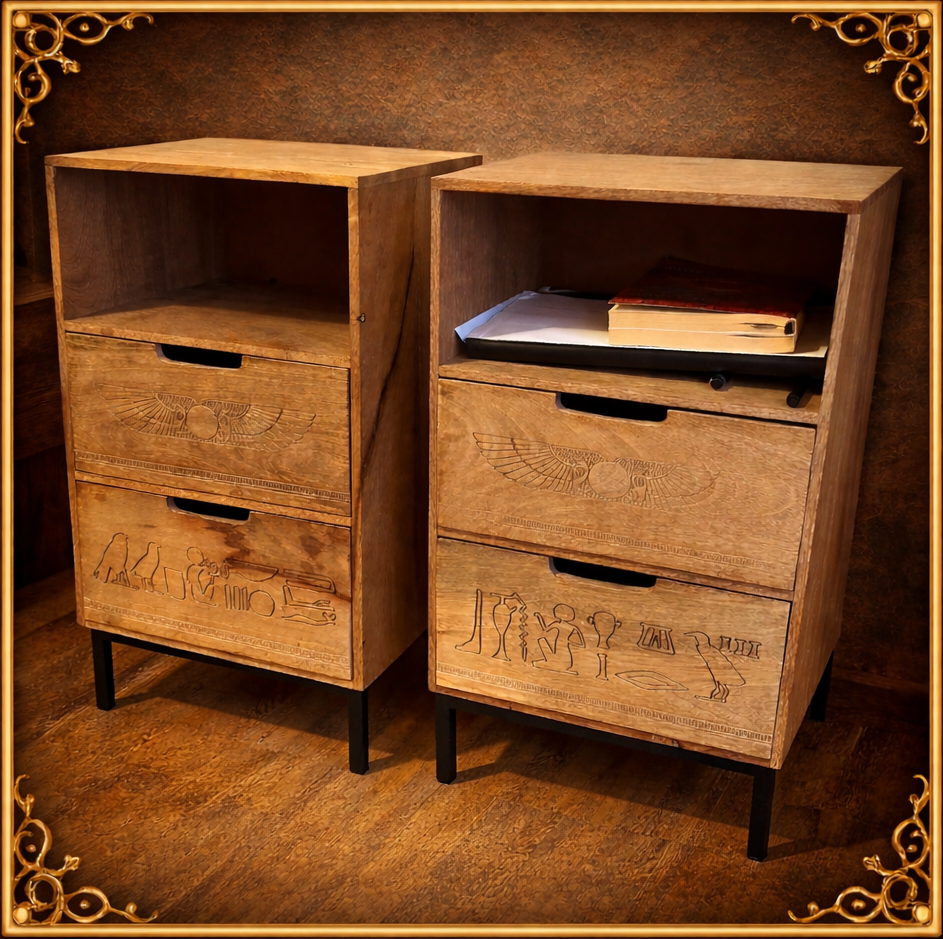
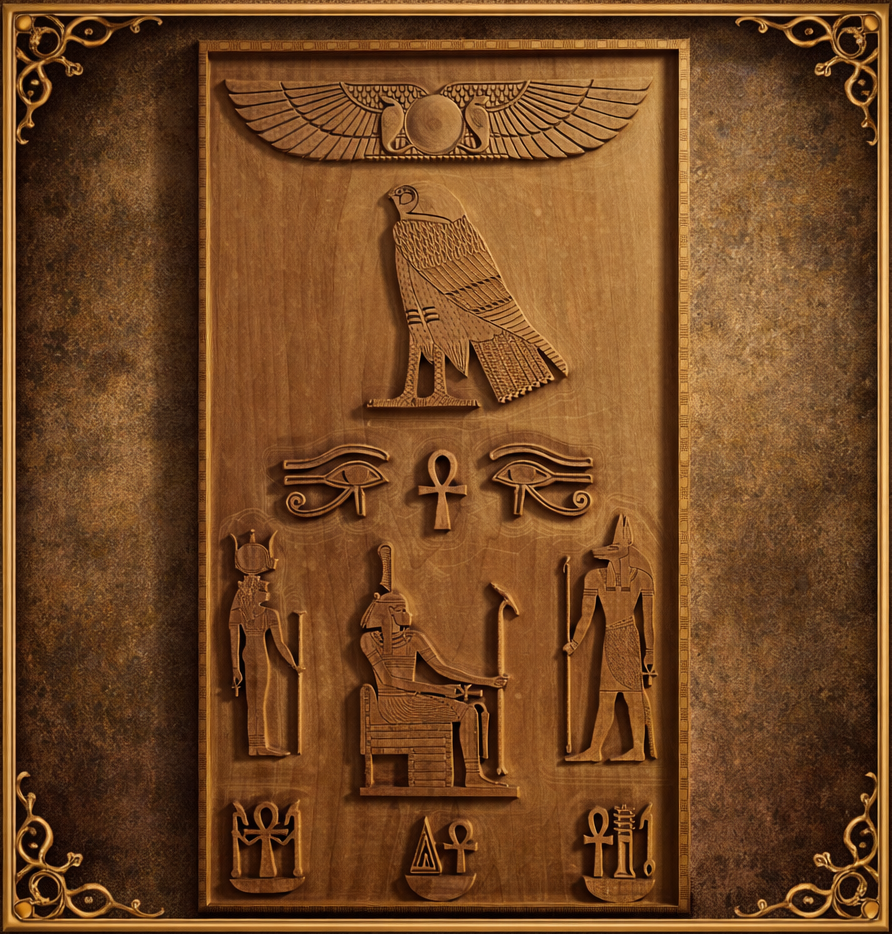
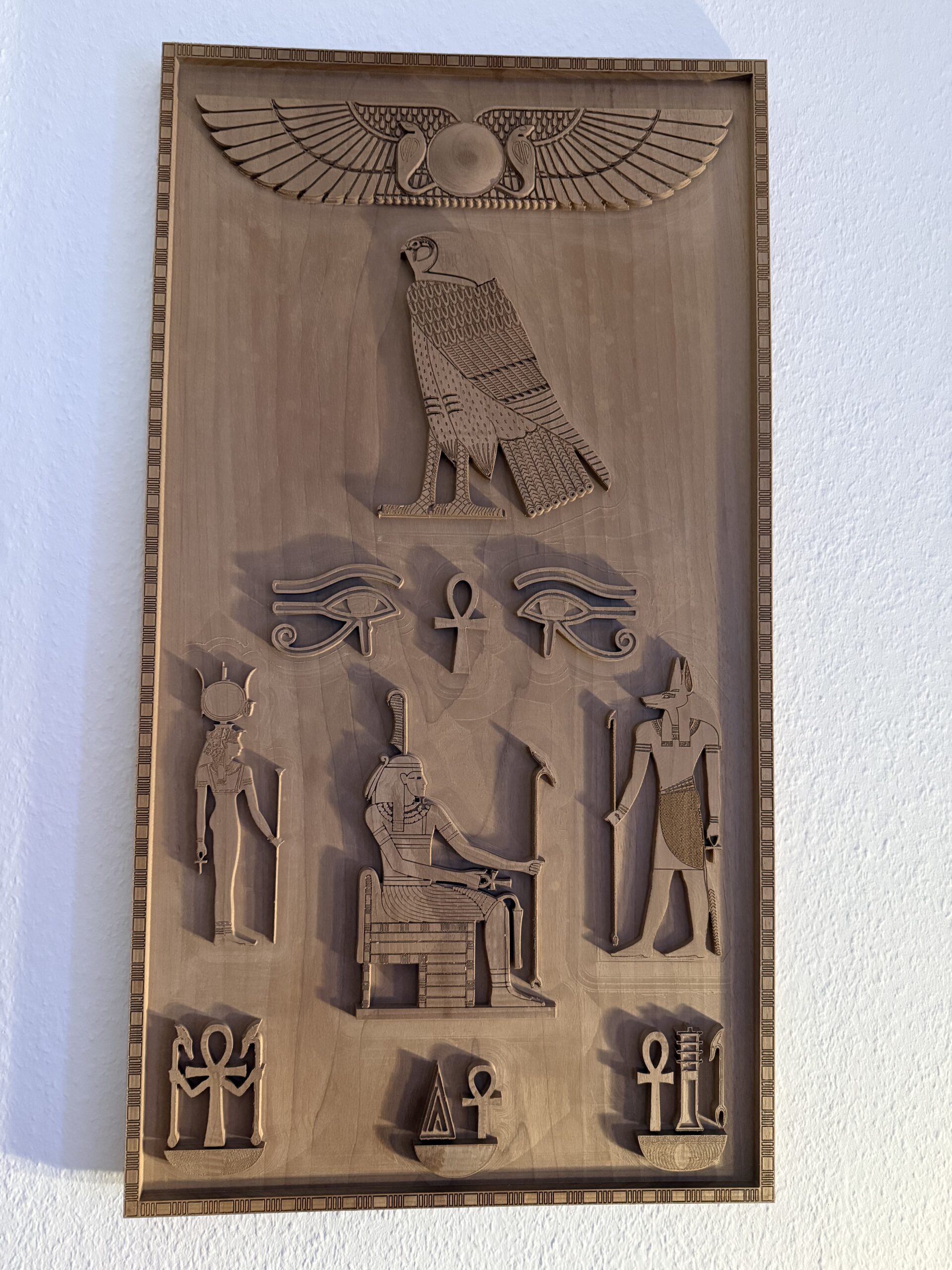
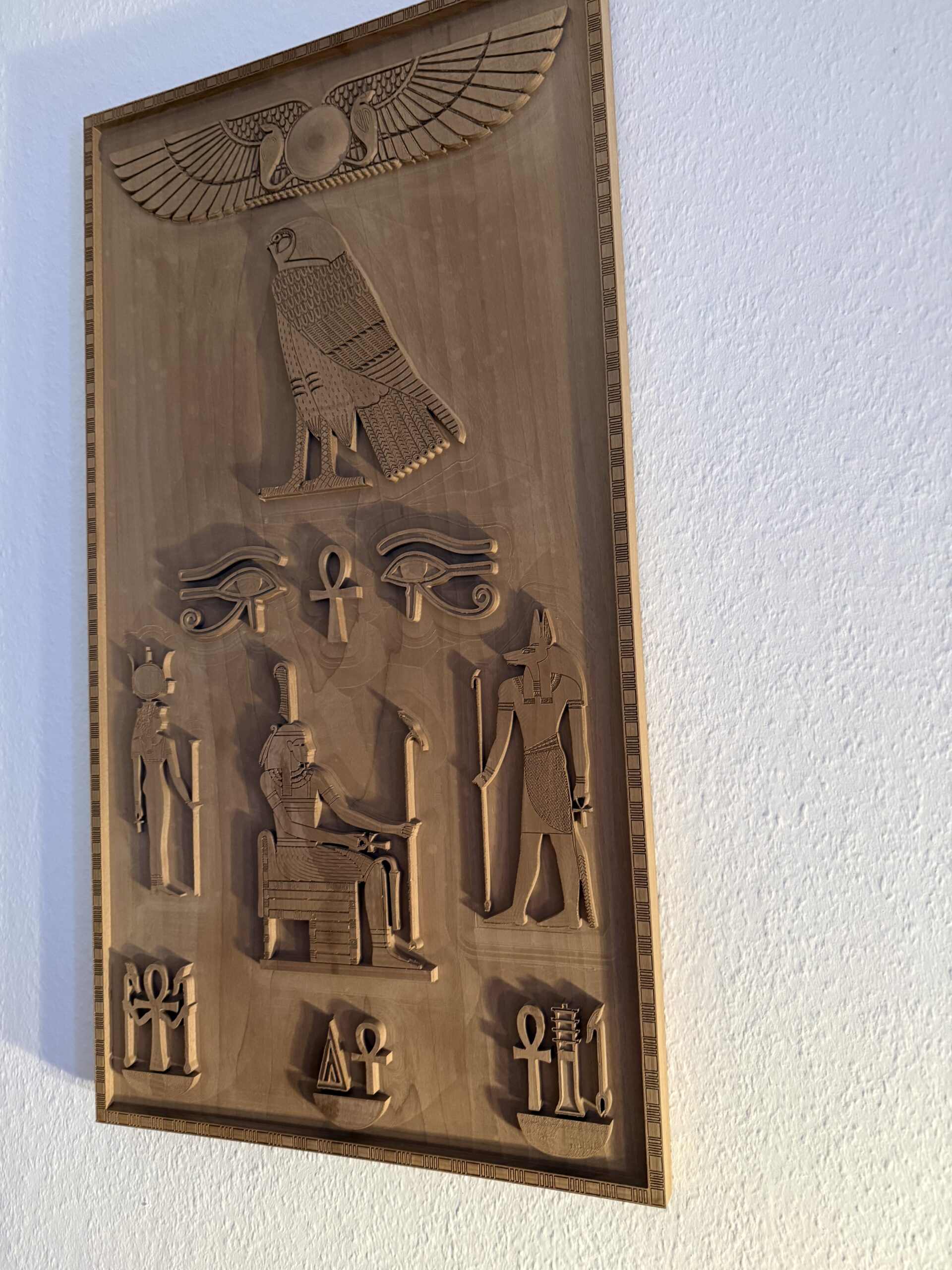
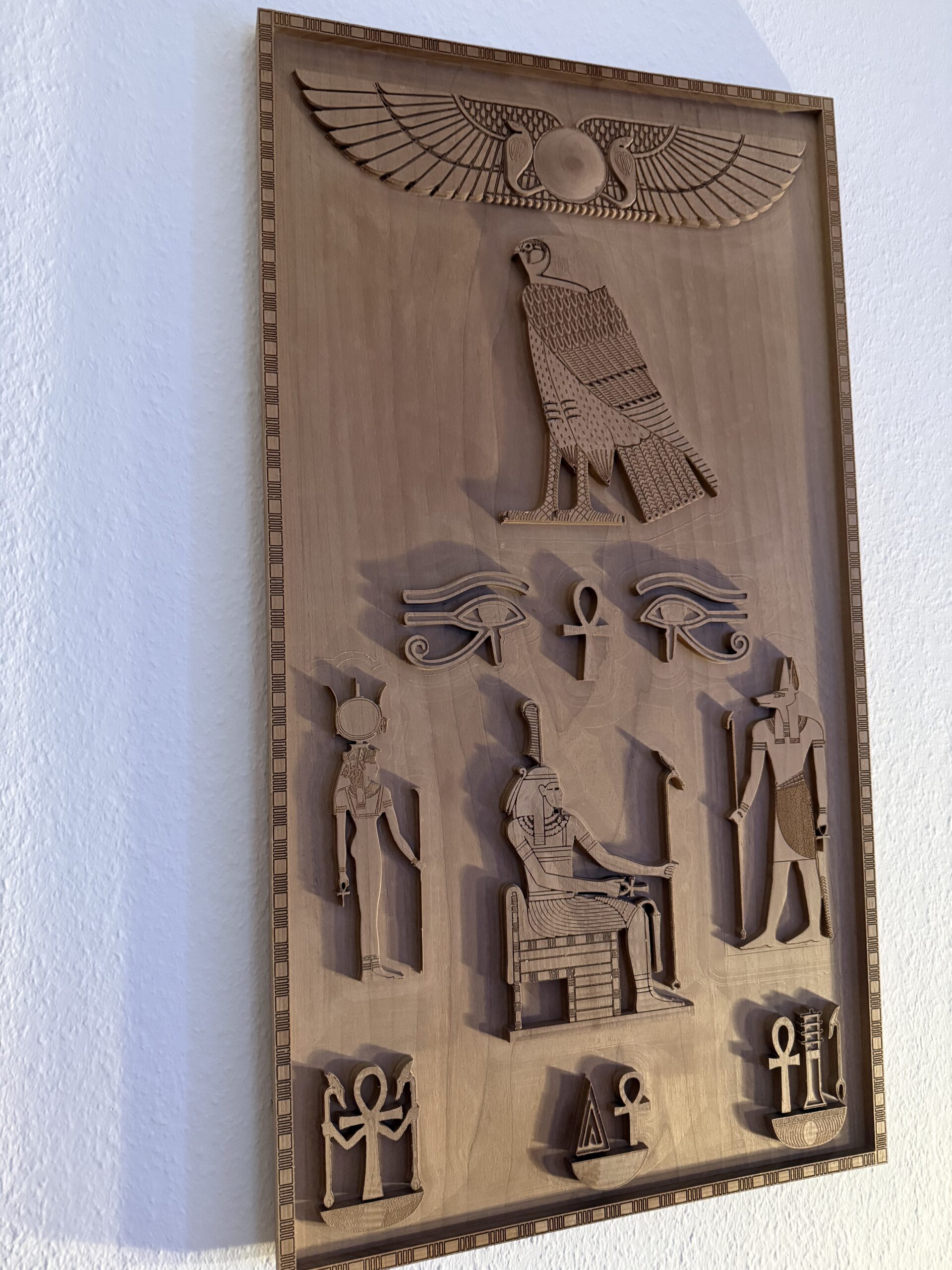
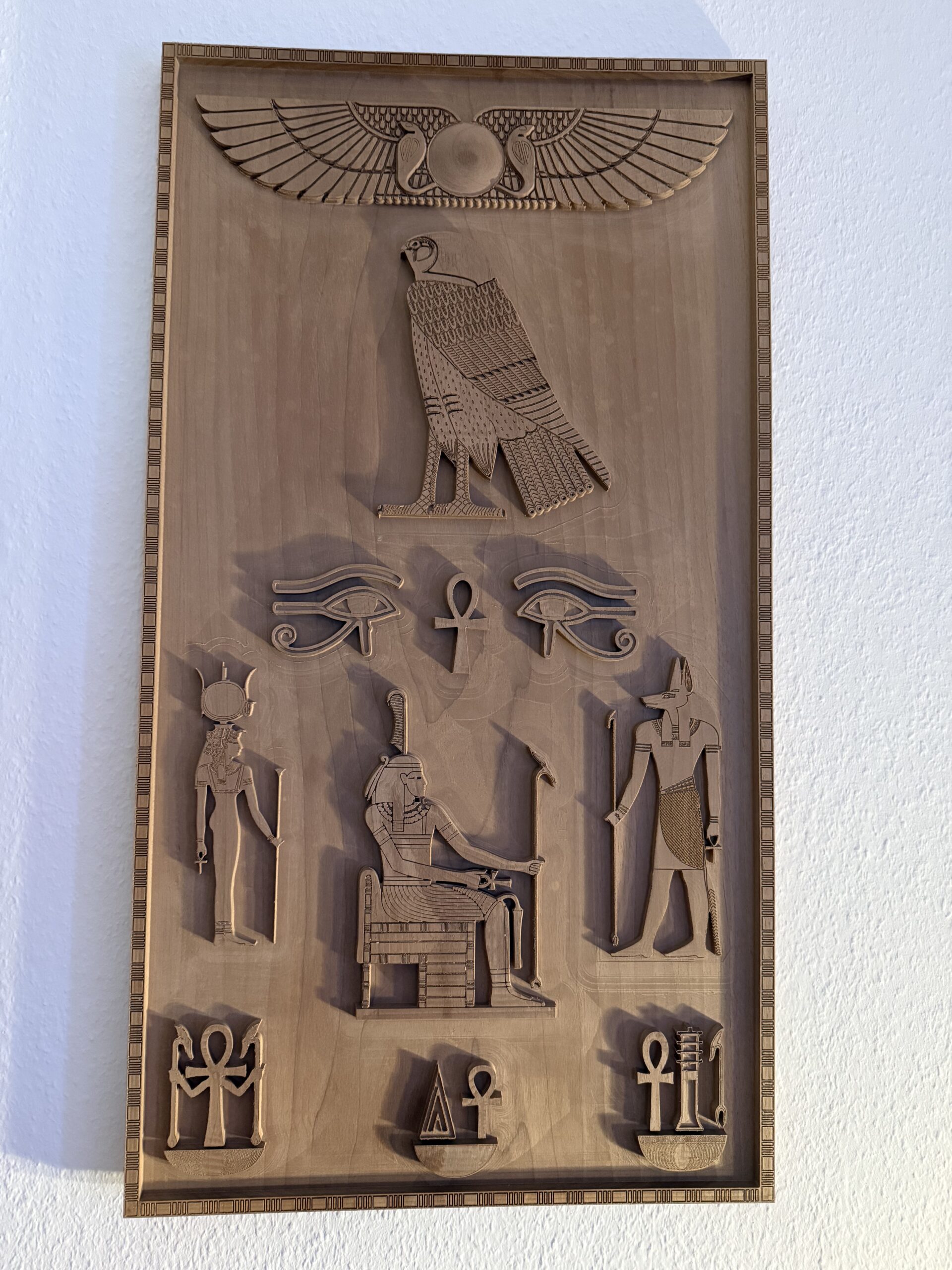
- This work is not a decorative relief. It is a contemporary sacred composition, carved into a single, living piece of walnut wood grown for over 80 years. Created as a unique piece and never to be reproduced, the work embodies a consciously constructed symbolic hierarchy rooted in ancient Egyptian theology.
- Each element follows a precise spiritual order — from the Winged Sun Disc to the divine triads of life, stability, and power — forming a temple-like structure within the material itself. The solid walnut, grown over eight decades and shaped from one uninterrupted block, carries a depth, density, and presence that cannot be replicated.
- This artwork carries sacred force — a divine power embedded in its symbolism and anchored within the wood itself. It is not merely a visual composition, but a spiritual structure filled with archetypal energy and cosmic authority. Every symbol represents order, transformation, and protection.
- Measuring 48 × 75 cm, the work radiates authority and a quiet, concentrated strength. It is not an object of decoration, but a presence that can be felt. To possess this work is to understand its essence — it is not something one simply owns, but a force one recognizes.
- Material: Walnut wood
- Dimensions: 48 × 75 cm
- Year: 2025
- Finish: Hand-finished
- Handcrafted: in Switzerland
Price inquiry:
- tel: +41 79 559 3 888
- email: info@nikov-art.ch
The Winged Sun Disc – Protective Symbol and Solar Primordial Principle
The upper section of the relief is crowned by the winged sun disc – a central symbol of ancient Egyptian religion. Historically, this motif is particularly associated with Horus of Edfu (Hor-Behudet), who in mythological traditions ascended to the sky as a great winged sun disc. At the same time, the sun disc is frequently identified with Ra, the sun god and creator deity. This ambiguity reflects the syncretism of Egyptian religion, in which deities merged and assumed different manifestations.
The outspread wings symbolize protection, divine power, and heavenly presence. They represent the protective force of the cosmos over the world of humankind.
Horus – Sky God and Embodiment of Royal Power
Beneath the sun disc appears Horus in the form of a falcon. Horus is one of the most significant gods of Ancient Egypt and represents the sky, light, and legitimate kingship. The falcon as a symbolic animal embodies foresight, superiority, and protection. In ancient Egyptian royal ideology, the pharaoh was regarded as the living Horus on earth, making religion and state authority inseparably connected.
The depiction of the falcon in the relief therefore emphasizes not only mythological but also political dimensions of Egyptian symbolism.
Udjat Eyes and Ankh – Cosmic Balance and Eternal Life
The two Udjat eyes, also known as the Eyes of Horus, stand for wholeness, healing, and spiritual integrity. Mythologically, they represent the sun and the moon – the two great lights of the sky. They symbolize restored balance after destruction and chaos and are considered powerful protective signs.
Between the eyes is the Ankh symbol, one of the most well-known symbols of Egyptian culture. The Ankh stands for life, life force, and immortality. It embodies the divine breath and the promise of eternal existence in the afterlife. In many depictions, the Ankh is handed by gods to humans – as a sign of divine life-giving power.
Isis, Ma’at and Anubis – Divine Principles Between Life and Afterlife
In the lower main register appear three significant deities who embody fundamental principles of ancient Egyptian religion.
Isis, depicted on the left, is the goddess of magic, motherhood, and healing. She is regarded as a protector and powerful sorceress who was even able to outwit the sun god. In astronomical interpretation, she is associated with the star Sirius, whose heliacal rising announced the flooding of the Nile – a sign of renewal and fertility.
Ma’at, seated in the center, symbolizes truth, justice, and cosmic order. Her principle permeates the entire ancient Egyptian worldview. Ma’at is not only a goddess but the universal law itself. In the judgment of the dead, the heart of the deceased is weighed against her feather – an image of moral integrity and ethical conduct.
Anubis, depicted on the right with a jackal head, is the guardian of the necropolises and guide of the deceased. He oversees the weighing of the heart and protects the soul during its transition to the afterlife. Anubis represents transformation, protection, and the threshold between life and death.
Lower Symbolic Compositions – Life, Stability, and Divine Power
The lower section of the relief presents three symbolic combinations that represent central blessing formulas of ancient Egyptian religion.
- Ankh + two Was scepters unite life and power. The Was scepter stands for dominion, authority, and divine enforcement. Together they signify life under divine protection and legitimate power.
Benben form (pyramid shape) + Ankh symbolize creation and rebirth. The Benben stone is considered the primordial mound of creation in the solar cult of Heliopolis. In connection with the Ankh, it expresses eternal life through cosmic renewal.
Ankh + Djed + Was form the classic triad: life, stability, and power. The Djed pillar stands for endurance and permanence, often associated with Osiris. This combination is a complete protective and blessing formula that guarantees divine harmony.